
How Much Does Virtual Staging Cost in 2026? AI, DIY, and Done-for-You Compared
A practical cost model for comparing AI subscriptions, DIY tools, curated services, and the hidden work behind a listing-ready staged photo package.
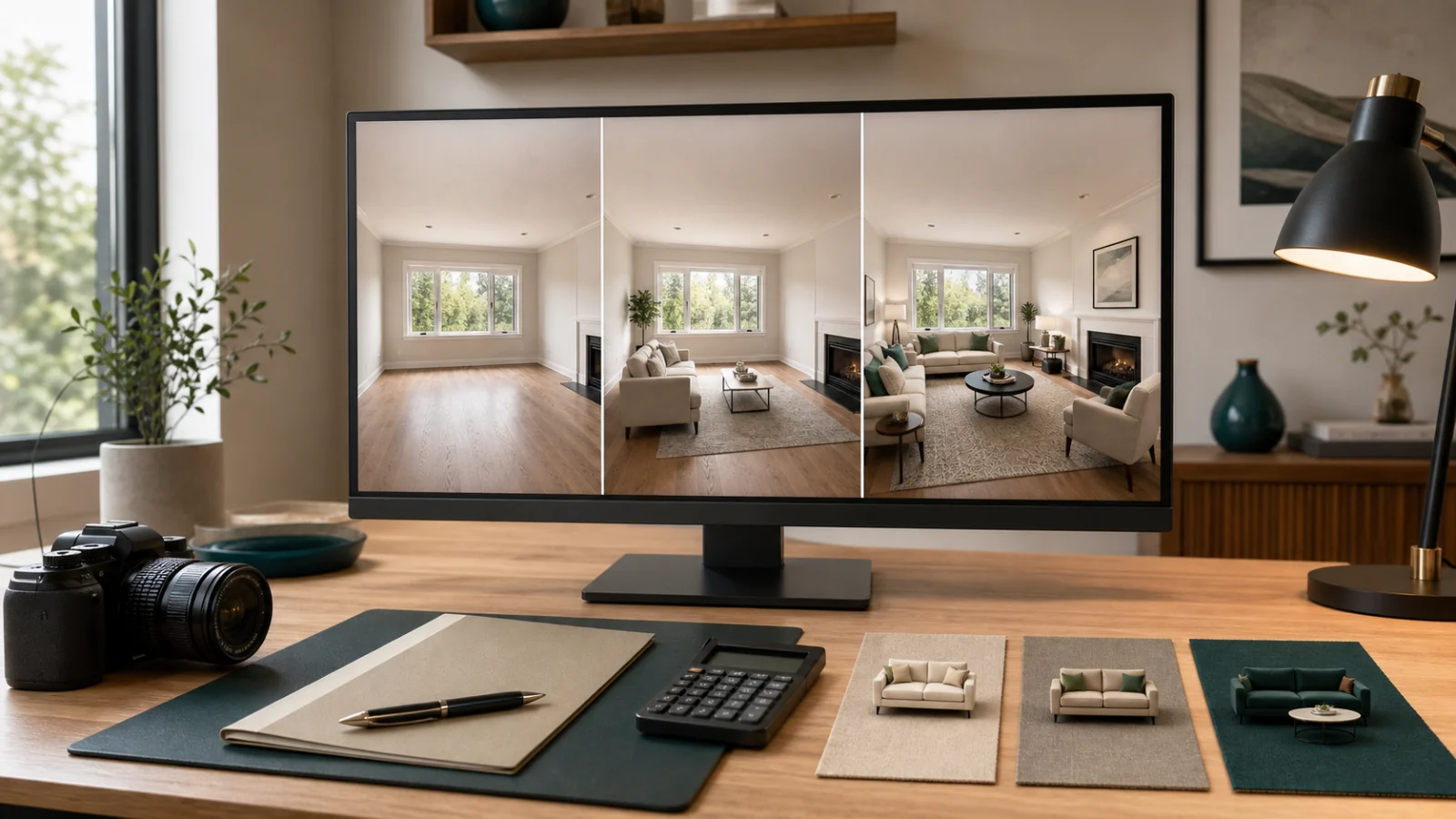
Virtual staging can cost less than $1 per downloaded image on a high-volume AI subscription, about $7–$15 per image for a guided DIY or pay-as-you-go workflow, and roughly $24 or more per image for a curated service. That is only the vendor charge. The real cost also includes writing the brief, selecting rooms, reviewing structure and scale, managing revisions, pairing originals, adding disclosure, and communicating with the seller or agent. For a typical listing, compare cost per approved image and total staff time, not the cheapest advertised generation. A low unit price becomes expensive when several candidates fail or feedback stays open-ended.
The four cost levels you are actually comparing
“Virtual staging” now describes several different products. Two services can both add a sofa to an empty room while selling very different levels of control, review, and accountability.
1. Self-serve AI subscription
This is usually the lowest advertised price per image. You upload a photo, choose a room type or style, generate candidates, and download the result yourself.
Virtual Staging AI currently advertises annual-billing plans ranging from 6 photos for $16 per month to 150 photos for $79 per month. Its displayed effective prices run from $2.67 to $0.53 per included photo. Those numbers assume you use the allowance and accept the billing commitment. Unused capacity, taxes, out-of-plan work, and your review time can change the effective cost.
This level works best when:
- rooms are vacant and photographed cleanly;
- the required design is conventional rather than exact;
- one person can review property geometry and artifacts;
- the listing has a clear deadline and approval owner;
- you have enough recurring volume to use the subscription.
It is a poor fit when the client expects exact furniture placement, matching furniture across several camera angles, or repeated subjective changes.
2. Guided DIY or pay-as-you-go staging
These tools trade the very lowest unit cost for more control or no monthly commitment. Apply Design currently lists coins at $10 each for up to 9, $8 each for 10–19, and $7 each for 20 or more. Its DIY 2D workflow uses one coin, while its one-click 2D workflow lists 1.5 coins. That makes the public vendor charge roughly $7–$15 per 2D image depending on volume and workflow.
This level is useful when an agent or photographer wants to control layout, make several versions, or avoid paying for a recurring allowance. The time cost can be higher because someone still needs to place or choose furniture and judge the result.
3. Done-for-you or curated virtual staging
A service team receives the brief and returns a finished image. BoxBrownie currently lists virtual staging at $24 per image without a subscription. A photographer may charge the client more than the vendor fee because the photographer owns intake, color preparation, upload, feedback, final quality control, delivery, and support.
Curated service is usually easier to justify when:
- the listing price or brand standard makes one failed image costly;
- the room has unusual dimensions or an awkward function;
- the client needs specific furniture or a controlled aesthetic;
- the schedule can accommodate the stated turnaround;
- the quote has a defined correction and revision policy.
“Done for you” does not automatically mean unlimited creative revisions. Confirm what counts as a correction, what counts as a new design, and how many rounds the price includes.
4. High-touch, multi-angle, or renovation-concept work
This is not simply “more AI.” Keeping the same furniture believable across two or more views can require a coordinated 3D or manual workflow. Changing finishes, cabinetry, landscaping, or walls is closer to a renovation concept and brings a different disclosure and approval burden.
Quote this work separately. The inexpensive single-image generation price is a misleading anchor when the deliverable requires:
- a shared furniture plan across viewpoints;
- masks or manual geometry correction;
- specific product or style matching;
- multiple stakeholder approvals;
- concept labels and original-image access;
- additional legal or MLS review.
If the property will not be changed to match the concept before closing, do not let a renovation rendering read like a photograph of its current condition.
A current price snapshot
Use this snapshot to understand pricing models, not to declare a universal market rate.
Prices in this guide were checked on July 25, 2026. Vendors change plans, allowances, and promotional rates frequently, so confirm the live checkout terms before quoting a client.
Subscription AI
- Public example: Virtual Staging AI.
- Displayed vendor cost: about $0.53–$2.67 per included photo with annual billing, depending on plan.
- Cost risk: paying for capacity you do not use.
- Labor risk: regeneration and quality review stay with you.
- Best for: repeat volume and standard vacant rooms.
Guided or pay-as-you-go
- Public example: Apply Design.
- Displayed vendor cost: about $7–$15 per 2D image based on coin volume and workflow.
- Cost risk: design time and optional new versions.
- Labor risk: layout decisions and final inspection.
- Best for: irregular volume or users who want more control.
Curated service
- Public example: BoxBrownie.
- Displayed vendor cost: $24 per image.
- Cost risk: turnaround and revision scope.
- Labor risk: briefing, handoff, and client feedback.
- Best for: managed delivery where human service is part of the value.
These are vendor prices, not recommended retail prices for photographers. Your selling price needs to cover the workflow around the image.
Why the cheapest generation may not be the cheapest approved image
Suppose an AI plan works out to $1 per included photo. You generate three candidates, spend eight minutes reviewing them, regenerate once after a window changes, and then answer two client messages. The tool line item is still tiny, but the job is no longer a one-dollar task.
Track these seven cost components:
- Source preparation. Color, exposure, perspective, and export quality affect staging quality.
- Briefing. Room type, target buyer, style, fixed elements, and forbidden changes need to be clear.
- Generation or vendor fee. Count all charged attempts, not only the final download.
- Quality control. Inspect windows, doors, fireplaces, outlets, flooring, reflections, shadows, furniture scale, and view.
- Revisions. Separate actual mistakes from preference changes.
- Delivery compliance. Label staged images and preserve access to the original where required.
- Client communication. Include intake, approval, and any handoff to an editor.
The useful metric is:
Cost per approved image = (tool and vendor charges + labor + allocated overhead) ÷ number of approved staged images
If you sell staging as a listing add-on, use a listing-level formula:
Listing gross margin = staging revenue − vendor charges − revision charges − labor cost − transaction or delivery costs
And calculate labor cost as:
Labor cost = total minutes for intake, production, review, revisions, and delivery ÷ 60 × loaded hourly rate
A $15 image with 20 minutes of staff time can be less profitable than a $24 image that arrives usable with a controlled handoff.
A worked example for a three-image listing
Imagine a vacant condo where the agent wants the living room, primary bedroom, and dining area staged.
The photographer charges $105 for the add-on. The tool charges total $12. Intake and room selection take 10 minutes. Generation and review take 24 minutes. One correction takes 8 minutes. Pairing originals, labeling files, and delivery take 8 minutes. Total labor is 50 minutes.
At a loaded labor rate of $42 per hour:
- Revenue: $105
- Tool cost: $12
- Labor: $35
- Gross margin before general overhead: $58
- Gross margin rate before general overhead: about 55%
Now imagine the agent asks for a different sofa, a warmer style, a new layout, and the same design in a second angle. Another 35 minutes and an extra vendor charge reduce the margin quickly. The right response is not necessarily a higher first-image fee. It is a clearer scope.
Price the approval process, not only the pixels
Recent discussions in r/RealEstatePhotography show a wide range of community quotes, from inexpensive AI add-ons to $35–$75 managed images. These are individual anecdotes, often mixed with vendor promotion, and should not be treated as an industry price survey. The repeated signal is more useful than the numbers: photographers say the feedback loop—different rugs, sofas, warmth, styles, and layouts—can erase margin.
A workable offer might include:
- one approved source photo per ordered image;
- one defined design direction;
- up to two generated candidates;
- one correction pass for defects or missed brief requirements;
- a separate fee for a new style, new layout, or new source;
- agent approval before publication;
- original-image pairing and disclosure-ready filenames.
Avoid “unlimited revisions” unless the vendor truly absorbs that work and your staff time is capped. Unlimited regeneration is not the same as unlimited human review.
Decide which rooms are worth paying to stage
Not every vacant room needs furniture. The National Association of REALTORS®’ 2025 staging report found that buyers’ agents ranked the living room as the most important room to stage, followed by the primary bedroom and kitchen. That supports a focused two-to-four-room package rather than staging every hallway, bathroom, and secondary bedroom.
Prioritize rooms where furniture helps answer a buyer question:
- Can a normal sofa and dining table fit?
- Does the primary bedroom hold a queen or king bed comfortably?
- Is an ambiguous area a dining zone, office, or circulation path?
- How does an open-plan room divide into functional zones?
Skip staging when the room’s function and scale are already obvious, the source is too distorted, or a staged image would create expectations the physical property cannot meet.
Cost and compliance belong in the same quote
In the United States, rules vary by jurisdiction, MLS, portal, and brokerage. The 2026 NAR Code of Ethics says REALTOR® advertising must present a true picture and must not use manipulations or images that create a deceptive or misleading result.
California’s AB 723, effective in 2026, requires a reasonably conspicuous alteration statement for covered real-estate advertising and access to the original, unaltered image. CRMLS guidance also says digitally altered images should be labeled and the unedited image included next to the enhanced version; ordinary lighting and color correction are treated differently from adding or removing objects.
That work has a cost. Your workflow needs to preserve the source, store the staged derivative, keep their relationship clear, and verify destination rules before upload. See the detailed virtual staging disclosure guide and MLS photo compliance workflow before publishing.
This article is operational guidance, not legal advice. Confirm the current rules for the property’s jurisdiction, MLS, brokerage, and advertising channel.
Questions to ask before choosing a pricing model
Use these questions with any AI tool, photographer, or staging service:
- Is billing per generation, per source, per download, per month, or per approved image?
- Do unused credits expire?
- Does a style change consume a new credit?
- Is furniture removal included?
- What resolution and file rights are included?
- Can the service preserve room geometry and fixed property elements?
- Can one design be coordinated across multiple angles?
- What is a correction versus a creative revision?
- Who checks the final image and approves publication?
- Does the workflow retain the original and support disclosure?
The cheapest answer to the first question rarely wins all ten.
FAQ
How much does virtual staging cost per photo in 2026?
Current public pricing spans from below $1 per included photo on some high-volume annual AI plans to roughly $7–$15 for guided DIY or pay-as-you-go workflows and around $24 or more for a curated service. Your effective cost should include labor, failed candidates, revisions, and disclosure delivery.
Is AI virtual staging cheaper than physical staging?
Usually, yes, when the goal is marketing images rather than furnishing the property for showings. NAR reported a $1,500 median spend when sellers’ agents used a staging service, but that survey covers home staging broadly and is not a virtual-staging price benchmark. Physical staging also changes the in-person experience; virtual staging does not.
How many photos should I virtually stage?
For many listings, two to four purposeful images are enough. Start with the living room and primary bedroom, then add a dining area, kitchen, or ambiguous flex space only when furniture clarifies scale or use.
Should a photographer charge more than the app costs?
Yes, if the photographer is providing selection, briefing, review, revision control, file management, disclosure preparation, and client support. The app fee is only one input. Make the included service visible so the client is not comparing managed delivery with a self-serve button.
Are virtually staged photos required to be labeled?
Requirements differ. Some laws, MLSs, brokerages, and portals require labels, original-image access, or specific upload order. Treat disclosure and original retention as part of the production workflow, then confirm the exact destination rule.
Build a controlled staging cost before you quote it
Run one real listing through Curbora’s AI virtual staging workflow, record the number of candidates and staff minutes required, and use the approved result—not the advertised generation price—to set your per-listing offer.
References
- Apply Design pricing, checked July 25, 2026.
- BoxBrownie virtual staging, checked July 25, 2026.
- Virtual Staging AI pricing, checked July 25, 2026.
- 2025 Profile of Home Staging, National Association of REALTORS®.
- 2026 Code of Ethics and Standards of Practice, National Association of REALTORS®.
- California AB 723 bill text.
- CRMLS 2026 Compliance FAQs, May 2026.
- Reddit: How much are you charging for virtual staging?, community anecdotes, March 2026.
- Reddit: How much are you charging for virtual staging?, community anecdotes, June–July 2026.