
Sky Replacement for Real Estate Photos: What Looks Natural and What Creates Risk
A cleaner sky can support an exterior; an impossible sky can undermine it. Use this checklist to keep replacement restrained and coherent.
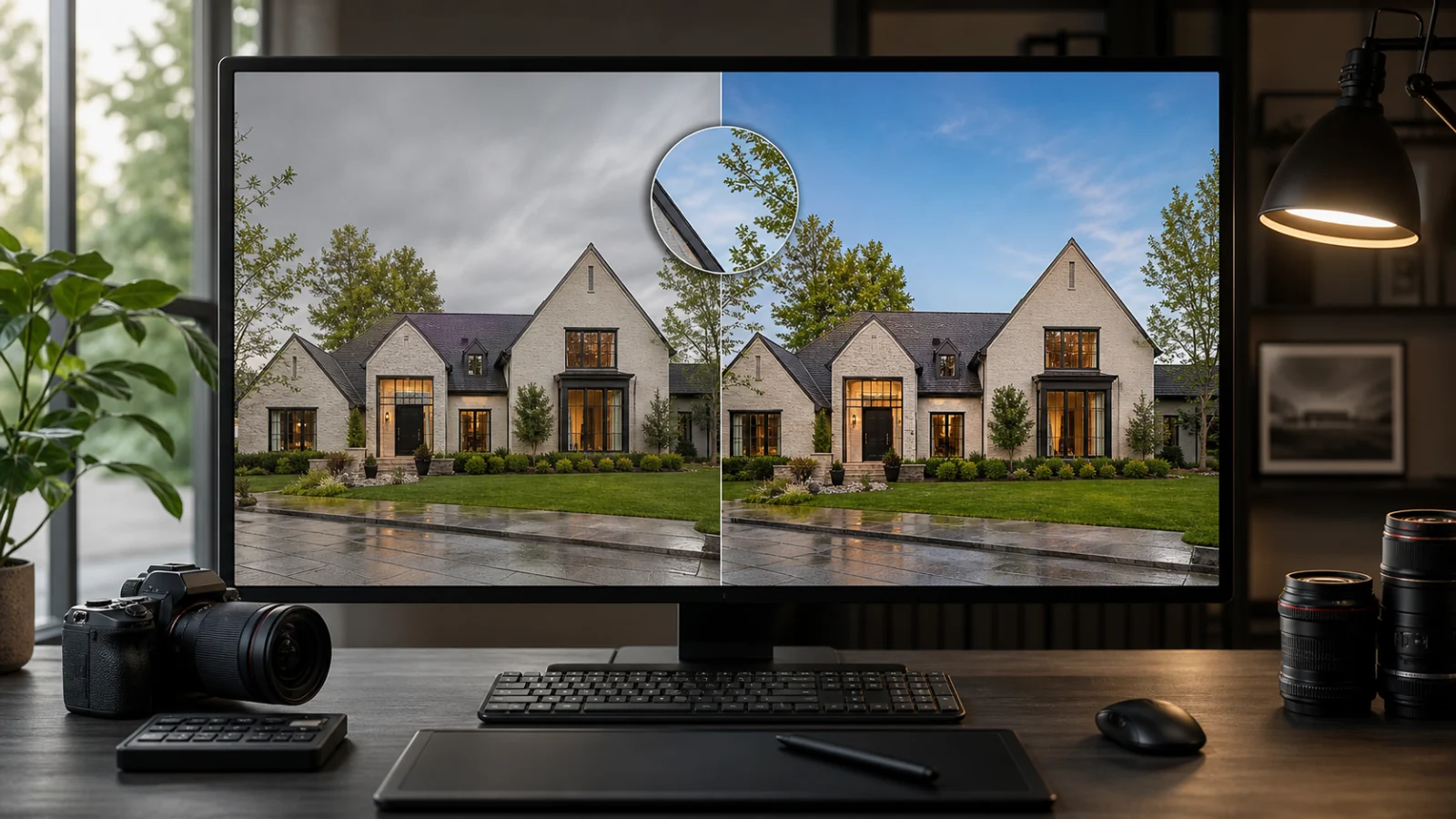
A natural real-estate sky replacement supports the photographed light instead of competing with it. Choose a sky whose sun direction, horizon brightness, cloud scale, season, and color temperature agree with the home and landscape. Preserve rooflines, trees, antennas, power lines, reflections, neighboring context, and visible weather evidence. Do not use the edit to invent a view, remove a permanent obstruction, turn wet pavement dry, or imply a sunset the property was never photographed under. Inspect fine edges and reflective glass at full resolution, keep the source, and confirm whether the listing platform requires disclosure. If the new sky demands extensive foreground relighting, it is probably the wrong sky.
Start with the foreground
The house tells you which sky can work. Shadows show light direction. Wet pavement shows recent weather. Tree movement and haze describe atmosphere. Warm highlights on a facade suggest a different source than flat overcast light.
Before opening a sky library, record:
- Direction and softness of foreground shadows.
- Brightness of the horizon behind the property.
- Color and density of reflections in windows and water.
- Weather clues on roofs, streets, and landscaping.
- Fine edge regions such as branches, railings, and utility lines.
The replacement should answer those clues. It should not require the foreground to tell a different story.
Choose restrained skies
For most listings, useful candidates have moderate cloud detail, believable scale, and enough tonal range to compress naturally with the exterior. Dramatic sunsets draw attention to the edit and create more lighting contradictions.
Avoid:
- Huge clouds that make the property look miniature.
- A bright sun disk without corresponding highlights and shadows.
- Saturated orange or cyan that contaminates neutral materials.
- Storm clouds over a brightly sunlit lawn.
- Reusing the identical recognizable sky across an agent’s portfolio.
The goal is not to win a sky contest. It is to present the home clearly.
Mask the difficult edges
Automatic sky selection is a starting point. Review:
- Roof tiles, gutters, chimneys, and antennas.
- Bare branches and fine leaves.
- Railings, pergolas, and cables.
- Mountains and distant buildings.
- Glass, pools, and polished vehicles.
Look for bright halos, dark fringes, missing gaps, semi-transparent leaves, and color spill. Adobe’s Sky Replacement offers edge shift, fade, brightness, temperature, scale, lighting, and color controls. Use them to integrate a suitable sky; they cannot make an unsuitable sky physically coherent.
Reflections must agree
If the new sky is visible in a large window, pool, or car, the original reflection may reveal the substitution. Do not automatically paste a second sky into every reflective surface. Reflections depend on angle, glass tint, interior brightness, and surrounding objects.
When the reflection cannot be made credible without reconstructing a large part of the scene, keep the original sky or reshoot. A small gray reflection beneath a dramatic blue sky is often more noticeable than the original overcast day.
Separate weather cleanup from property change
A sky replacement should not quietly:
- Remove power lines or neighboring buildings.
- Add mountains, water, or a skyline.
- Repair a roof edge.
- Change trees from one season to another.
- remove rain evidence from the ground.
- Add exterior lighting or window interiors.
Those changes alter context or condition. They require separate review and may be inappropriate regardless of technical quality.
Match the whole listing, not just one exterior
If several photos show the sky, review them together. Clouds do not need to be identical, but weather, horizon color, and light direction should describe the same period. Repeating the exact cloud formation from opposite directions is a recognizable artifact. Using a bright blue noon sky on one frame and late golden light on the next is a narrative contradiction.
Interior windows matter too. An exterior sky replacement can conflict with a gray or rainy view visible from inside. The safest solution may be to keep a subtle neutral sky across the set instead of expanding the edit into every glass surface.
Build a small, traceable sky library
Photographers who use captured sky plates should record approximate direction, time of day, focal character, and licensing. Group plates by overcast, light cloud, clear blue, and blue hour. A small appropriate library is easier to review than thousands of dramatic options.
Do not assume a downloaded sky is licensed for commercial compositing. Keep the source and rights record with the project or use a tool whose terms support the intended output.
Know when cleanup is enough
A flat sky can often be improved with highlight recovery, contrast, haze control, and selective color rather than replacement. This preserves real cloud structure and reflections. Try the least synthetic correction first.
Use replacement only when it materially improves clarity, the mask and foreground can remain coherent, the license is clear, and the listing professional accepts the disclosure policy. If those conditions are not met, a clean gray sky is not a production failure.
Archive the exact sky source or generated version with the final. If a client later requests a different crop or another exterior angle, the editor can preserve weather and color continuity without searching for a similar-looking asset. The record also supports licensing and disclosure review.
Quality-control checklist
- ☐ The source and final crops match.
- ☐ Sun direction and shadow softness agree.
- ☐ Horizon brightness fits the foreground.
- ☐ Clouds have believable scale and perspective.
- ☐ Roof, branch, railing, and cable edges are clean.
- ☐ Windows and reflective surfaces do not contradict the sky.
- ☐ Permanent context and visible condition remain.
- ☐ Saturation and color spill are restrained.
- ☐ The source file is retained.
- ☐ Disclosure requirements have been confirmed.
For full dusk conversions, use the more comprehensive day-to-dusk workflow. For final delivery, add the listing photo editing checklist.
Frequently asked questions
Is replacing a gray sky always misleading?
Not automatically, but rules and client expectations vary. The key issues are whether the edit changes a material claim, whether it remains coherent, and whether disclosure is required.
Can I use the same blue sky for a whole listing?
Consistency can help, but angle and reflection differ between photos. Evaluate each frame; an identical cloud pattern repeated in several directions looks artificial.
Should I replace a blown-out white sky?
Only if edge detail and foreground light support a credible result. A subtle pale sky is usually safer than a saturated one.
Does AI make masking review unnecessary?
No. Fine branches, roof edges, reflections, and cables remain common failure points. Review at delivery resolution.
Keep the exterior believable
Apply a restrained sky and foreground correction as one reviewed edit, with the source preserved for comparison. Try the real estate photo editor.