
Best Virtual Staging for Real Estate: How to Compare Tools Without Trusting Demo Images
A beautiful demo does not prove a tool will preserve your room. Compare staging products with controlled sources and a structural-fidelity score.
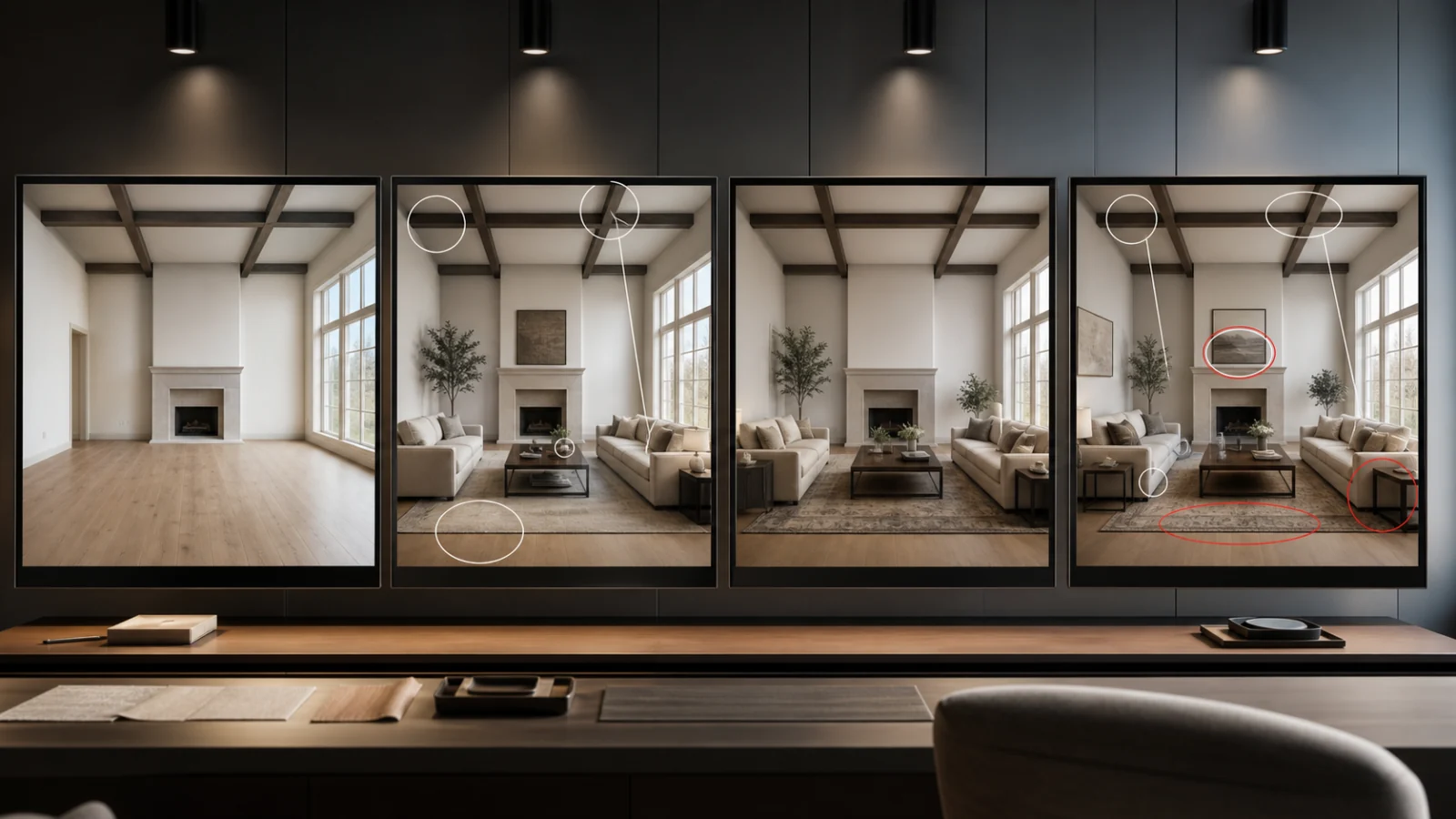
The best virtual-staging tool is not the one with the prettiest curated gallery. It is the one that preserves your source room, produces useful furniture at delivery resolution, supports your disclosure workflow, and reaches an accepted final with predictable cost. Test every candidate with the same vacant rooms: a simple bedroom, a bright-window living room, a difficult open-plan space, and two angles of one room. Score walls, doors, windows, floors, built-ins, perspective, scale, shadows, artifacts, style control, and original-to-final pairing. Reject any result that quietly remodels the property. Then compare revision time, export limits, privacy, and current price.
Build a four-room test
Simple bedroom
Tests basic furniture scale, floor contact, door clearance, and style adherence.
Bright-window living room
Tests whether the model changes panes, curtains, views, light direction, and reflections.
Open-plan or complex room
Tests boundaries, circulation, beams, stairs, multiple openings, and whether the model invents walls.
Two angles of one room
Tests design continuity. Independent generators may create attractive but incompatible furniture and layouts.
Use high-resolution, authorized sources with no pre-existing edits that could confuse the comparison.
Score property fidelity first
Create a hard-fail list:
- Wall, door, window, ceiling, floor, fireplace, cabinet, or view changes.
- Visible damage or condition disappears.
- Room proportions change.
- New permanent lighting or built-ins appear.
- Furniture hides a material feature deliberately.
An attractive image that fails here should not be rescued by a high style score.
Score staging quality
For candidates that preserve the room, review:
- Furniture scale and perspective.
- Clear doors and circulation.
- Contact shadows and reflections.
- Object completeness and clean edges.
- Style match to the requested reference.
- Appropriate density for the room.
- Plausible use without exaggerating dimensions.
- Coherence across the listing.
Review at 100 percent and at card-thumbnail size. Both matter for publication.
Test control and revisions
Ask the same change:
- Remove one chair.
- Reduce decor.
- Preserve the layout but shift to a slightly warmer palette.
Observe whether the tool changes only the request or regenerates the entire room. A low first-image price can be expensive if every correction creates new errors.
Use the virtual staging revision pricing framework to separate corrections from new concepts.
Test disclosure and file handling
A production tool should support a transparent project record:
- Retain the original source.
- Keep source and final associated.
- Allow clear edited-image naming.
- Export the required resolution and profile.
- Preserve review history where practical.
- Fit the MLS or jurisdiction’s labeling and pairing requirements.
Read the virtual staging disclosure guide before defining delivery.
Compare cost correctly
Include:
- Subscription or credit price.
- Charge per generation and regeneration.
- High-resolution export.
- Watermark removal.
- Furniture removal before staging.
- Revision labor.
- Human QC.
- Failed candidates.
- Storage and transfer.
Verify current pricing and limits directly. Public service pages change, and similar-sounding credits may cover different tasks.
Review privacy and rights
Ask:
- Are uploads used for model training?
- How long are sources and finals retained?
- Can staff or contractors access them?
- What rights apply to generated furniture and delivered images?
- Can the project be deleted?
- Are property photos shown in public galleries by default?
Confirm terms that fit your clients and jurisdiction.
Test the output as a listing set
Do not score only isolated rooms. Put every source and candidate into the order a buyer would see them. A tool can produce five attractive images that fail as one property because furniture scale, style, light, or color changes abruptly.
Review:
- Whether the staged image can be paired with its exact vacant original.
- Whether adjacent rooms share an intentional style without looking duplicated.
- Whether the staged rooms remain consistent with the price point and architecture.
- Whether a buyer could confuse two independently generated versions of the same room.
- Whether the card thumbnail still makes the edit easy to understand.
The most useful set often stages fewer images. Publish enough to communicate room use, then let the originals carry condition and spatial evidence.
Include a failure-handling test
Deliberately submit a difficult source and observe what the product does. A trustworthy workflow should fail visibly, request a better input, or let the reviewer reject the candidate. It should not hide uncertainty behind a photorealistic redesign.
Check whether:
- Failed generations consume credits.
- A source can be reprocessed without losing history.
- Support can identify why the result failed.
- The original remains downloadable.
- A human review option exists for important work.
Predictable failure is part of production quality. A tool that is excellent 80 percent of the time but silently changes the property in the other 20 percent needs a stronger review gate than one that clearly flags uncertain images.
Build an approval record
For each accepted stage, retain the source, final, chosen style, review date, and approver. Record any fixed-feature check and the disclosure wording supplied to the listing professional. This record is more useful than retaining dozens of rejected generations with no explanation.
Repeat the comparison after a major model update. Use the same sources, prompts, and hard-fail rules, because a new version can improve furniture while regressing windows or geometry. Date every conclusion rather than presenting a tool choice as permanent.
A weighted decision
Use a hierarchy rather than a beauty average:
- Property fidelity: mandatory.
- Export and disclosure fit: mandatory.
- Artifact and scale quality: high weight.
- Revision predictability: high weight.
- Style range: medium weight.
- Speed and price: medium weight.
This prevents a fast, stylish tool from winning after it changes the room.
Frequently asked questions
How many outputs should I generate per source?
Use the same small number for every tool. Too many attempts can hide a low success rate and inflate cost.
Should I test furnished-room removal?
Only if it is part of your real workflow. Large removal requires reconstructing hidden property surfaces and should receive separate fidelity review.
Can one tool keep furniture identical across angles?
Some workflows provide stronger scene controls, but independent image generation often drifts. Test it directly and do not assume visual similarity means spatial consistency.
Are free virtual staging tools good enough?
They may be useful for screening, but check resolution, watermarks, rights, data use, and exports before production.
What is the most important failure?
Changing fixed property facts or visible condition. Treat that as a rejection, not a preference revision.
Compare Curbora with the same source set
Generate staging candidates from your own vacant rooms, retain the originals, and score structural fidelity before style. Try AI virtual staging.