
Virtual Staging Revisions: How to Price the Work, Not Just the Image
A clear revision policy protects the client relationship and the editor’s margin. Here is a practical way to define included changes, new concepts, and rework.
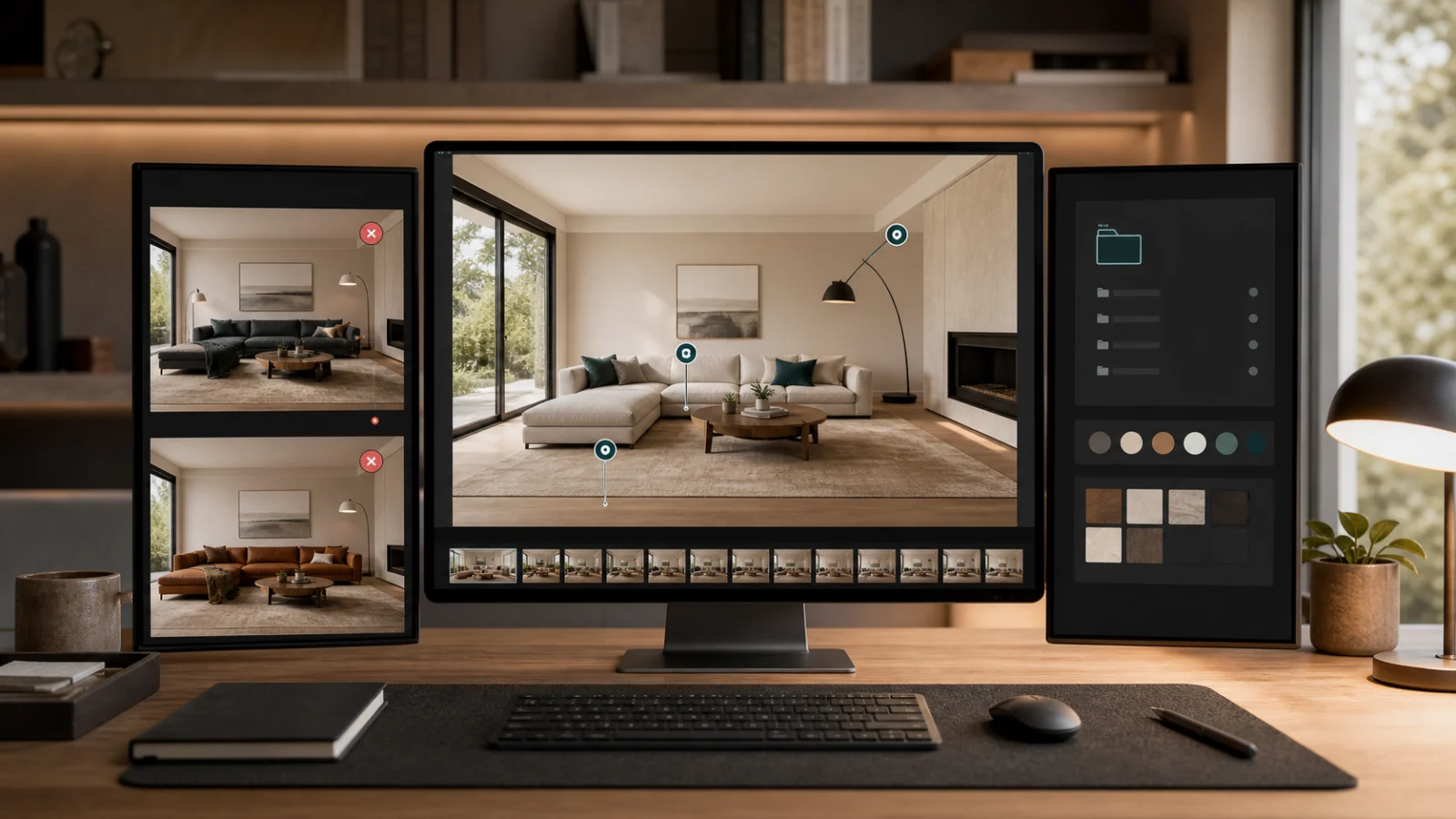
Price virtual staging around the approved scope, not around the number of exported JPEGs. A sensible base price covers one source photo, one room type, one agreed style, and a defined number of correction rounds. Fixes to mistakes—floating furniture, altered windows, broken masks, or a missed brief—belong in that base price. A request for a different furniture style, a new room use, another source angle, or a restart after approval is new creative work and should be quoted separately. Put response times, review rounds, source requirements, and the definition of a revision in writing before production. Clients gain predictable costs, while editors avoid turning an inexpensive image into an open-ended design engagement.
Why per-image pricing becomes ambiguous
“One virtually staged image” sounds like a complete unit, but the work contains several decisions: room function, furniture style, density, color palette, layout, source cleanup, disclosure, and final export. If the brief does not settle those decisions, the first result becomes a discovery exercise.
That ambiguity creates two bad outcomes. The editor absorbs repeated concept changes, or the client receives surprise charges for corrections they reasonably believed were included. A revision framework separates production responsibility from a new direction.
Define the base deliverable
A useful base package states exactly what the buyer receives:
- One supplied source image at the required resolution.
- One specified room type, such as living room or primary bedroom.
- One chosen style direction, supported by a reference image or short visual brief.
- One staged final at the original crop and agreed export dimensions.
- Technical quality control for geometry, masks, light, and fixed features.
- A stated number of consolidated review rounds.
- Delivery of the original and labeled staged version when required.
This is more precise than “two revisions included.” A client could otherwise interpret a revision as an entirely new contemporary layout after first requesting traditional furniture.
Corrections should not consume creative rounds
An editor should correct failures against the approved brief without charging a creative-change fee. Examples include:
- Furniture intersects a wall or floats above the floor.
- A window, door, fireplace, or built-in changed.
- A requested room type or agreed style was ignored.
- A masking halo, duplicated object, or broken reflection is visible.
- The delivered file has the wrong size, crop, format, or color profile.
These are acceptance defects, not preference changes. Recording them separately builds trust and also reveals recurring production problems.
What counts as a billable change
New work begins when the requested outcome changes after a compliant candidate has been delivered. Common examples are:
- Replacing the entire furniture style.
- Turning a bedroom concept into a home office.
- Producing multiple alternatives for agent or seller voting.
- Restaging from a newly supplied source photo.
- Changing the crop or perspective enough to require a new composite.
- Reopening an approved image after the project has closed.
- Removing or altering fixed property features beyond the original scope.
The last item may need to be declined rather than priced. A paid change is not automatically an appropriate listing edit.
Use three levels instead of one revision fee
A simple tier model is easier to explain than measuring every mouse movement.
Minor correction
A minor correction preserves the approved concept and changes a limited movable element: replace one chair, reduce decor, adjust a rug, or correct a local mask. It has low review risk and usually stays within an included round.
Layout revision
A layout revision keeps the room use and style but reworks several objects or the composition. It may require a partial regeneration and a full geometry review. Quote it as a meaningful fraction of the original staging price.
New concept
A new concept changes the room use, style, source, or creative direction. Treat it as another staged image, even if the file name and camera angle are the same. The labor and approval risk are close to starting over.
The exact amounts depend on your production model. The important point is that the policy maps client intent to scope before a price is applied.
Account for source difficulty
Two living-room images can require very different effort. Price or qualify the source before accepting the job.
Higher-risk inputs include:
- Low resolution or aggressive compression.
- Heavy wide-angle distortion.
- Furniture that must be removed before new staging can begin.
- Mirrors, glass walls, complex railings, or glossy floors.
- Occluded doors, windows, or floor boundaries.
- Strong mixed lighting or blown highlights.
- Multiple angles that must maintain the same design.
Create a separate rate or manual-review step for these cases. A low base price is not useful if the majority of margin disappears in source repair and review.
Control feedback, not just output
Require one decision-maker and one consolidated comment set per round. When an agent, seller, photographer, and designer send independent notes, they may contradict one another. A round should begin only after the client resolves those conflicts.
Ask reviewers to identify:
- The object or region to change.
- Why it conflicts with the approved brief.
- Whether the current room use and style remain approved.
- A reference if the preference cannot be described clearly.
- The deadline and whether it changes the original delivery priority.
Visual annotations are more reliable than messages such as “make it warmer” or “make it more luxurious.” They reduce interpretation and create an audit trail.
Build turnaround into the policy
The initial turnaround does not automatically apply to every revision. State the service level for:
- Corrections caused by production defects.
- Minor preference changes.
- New concepts.
- Requests received after the daily cutoff.
- Weekend or rush review.
Do not promise instant changes if the workflow still requires source comparison and full-resolution QC. Speed without review is how altered windows, floating furniture, and disclosure mistakes reach a listing.
A practical quote template
A short scope note can prevent a long dispute:
Includes one staged concept from the supplied source, using the approved living-room style reference, plus one consolidated preference round. Corrections required to match the approved brief are included. A different style, room use, source image, or request after final approval is quoted as a new concept. Fixed property features will not be altered.
Add export size, delivery time, disclosure handling, tax, payment terms, and archive period according to your business.
For wider market context, see what virtual staging costs. Public competitor rates can be useful reference points, but compare what is included: some services price enhancement, staging, decluttering, and twilight conversion as separate units.
Track the reason for every revision
Use a small set of reason codes:
- Production defect.
- Brief ambiguity.
- Client preference.
- New concept.
- Source replacement.
- Compliance refusal.
After several projects, the distribution tells you what to fix. Too many brief-ambiguity revisions suggest a better intake form. Too many production defects suggest stronger QC. Too many late preference changes suggest a clearer approval gate.
Frequently asked questions
How many revision rounds should be included?
One consolidated preference round is a common workable starting point, while technical corrections remain included until the result matches the agreed brief. The right policy depends on price, turnaround, and client type.
Is changing the sofa a revision or a new image?
Replacing one sofa within the same layout and style is usually a minor revision. Rebuilding the room around a new style or layout is a new concept.
Should AI-generated staging revisions cost less?
Automation can reduce candidate-generation time, but review, source fidelity, masking, communication, and compliance still carry cost. Price the complete accepted deliverable, not the duration of one generation call.
What if the client asks to remove a permanent defect?
Do not treat every request as purchasable scope. Explain the representation risk, preserve the original, and ask the listing professional to confirm an appropriate, disclosed use before proceeding.
Should the original file be archived?
Yes. Keep the source, approved brief, generated candidates, final, and review record for a defined retention period. State that period in the terms.
Make the first brief do more work
Start with a clear source, room type, and style so revisions stay focused on quality rather than rediscovering the concept. Create an AI virtual staging candidate.