
Window Recovery vs. Window Pulls: Single Images, Brackets, AI, and Photoshop
A clear window can come from several workflows, but they do not contain the same evidence. Choose by the source, the view, and the final claim.
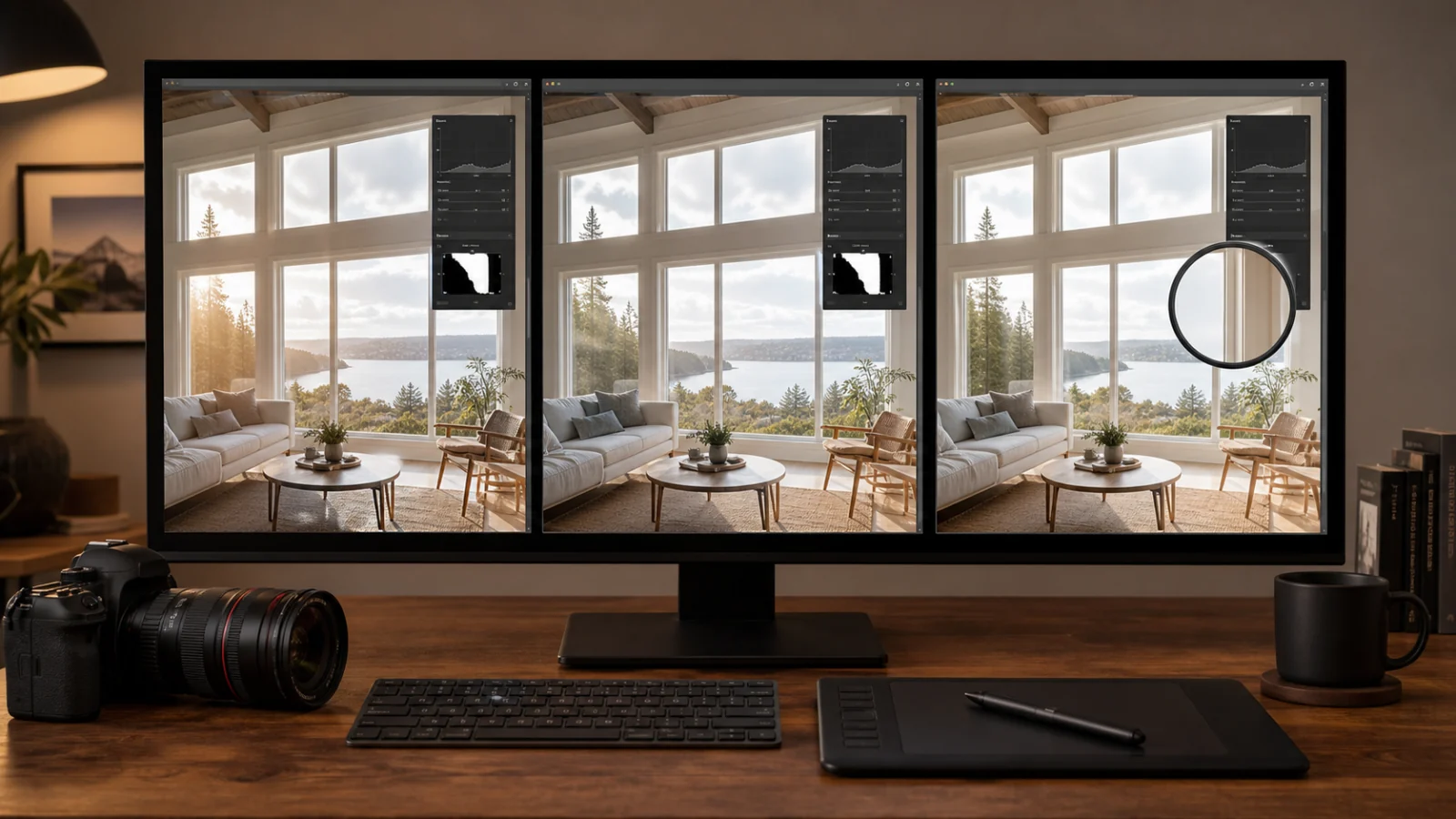
“Window recovery” describes an outcome, not one technique. A single RAW file may contain enough highlight detail to lower the window naturally. Exposure brackets can merge a darker frame into the interior. A flash window pull records a controlled exterior-facing exposure with different light. Manual Photoshop blending combines selected evidence, while AI enhancement may identify and rebalance the window region. These methods are only truthful when the final comes from captured information. If a window is clipped to white in every source, a generated landscape is not recovery. Choose the least complex workflow that preserves frames, reflections, curtains, exterior perspective, and the room’s natural tonal hierarchy.
Single-file highlight recovery
Use one RAW when the camera captured enough dynamic range and the view is not central to the marketing claim. Lower highlights and whites, then use a restrained local mask.
Advantages:
- Fast and simple.
- No alignment or movement problems.
- Natural reflections remain.
- Easy to keep consistent across a batch.
Limits:
- Clipped pixels contain no exterior detail.
- Deep recovery can produce gray windows, noise, or color shifts.
- Bright edges may halo against dark frames.
A JPEG or downloaded MLS image provides less latitude than the original RAW. Evaluate the source before promising a view.
Bracket-based recovery
A darker bracket can record exterior detail while lighter frames record the room. Merge the set as HDR or blend the relevant exposure manually.
Advantages:
- Uses captured detail across a wider range.
- Works without flash when the scene is stable.
- Can preserve a natural relationship between interior and exterior.
Limits:
- Moving leaves, curtains, people, and reflections can ghost.
- Frames must align.
- An excessively dark exterior can look pasted in.
- Processing requires more capture and review time.
Read the HDR real estate editing workflow for capture, merge, and deghosting details.
Flash window pulls
A flash window pull typically uses a darker exposure and flash aimed to define window frames, producing a clear mask or blend source. It can be effective when a valuable view must remain crisp.
Advantages:
- Strong separation around window edges.
- Controlled source for manual blending.
- Useful when ambient brackets create flare or weak frames.
Limits:
- Reflections and flash artifacts require experience.
- Curtains, plants, and complex frames can complicate the mask.
- The exterior can become unnaturally dark or saturated.
- It adds capture steps on site.
The flash frame is usually an ingredient, not the finished room.
AI enhancement
AI can locate windows and rebalance a valid source quickly. It is useful for moderate clipping, batch consistency, and a first-pass candidate. It needs special scrutiny when the source contains no view, because generative behavior may invent trees, buildings, or sky.
Ask:
- Does the exterior exist in any source file?
- Do the window panes and mullions match?
- Is the view consistent across other angles?
- Are season, weather, and sun direction plausible?
- Did the tool change curtains, blinds, or reflections?
Curbora can enhance independent source photos and recover available window detail. It does not merge RAW bracket stacks or guarantee reconstruction of missing exterior information.
Manual Photoshop blending
Manual blending gives the reviewer direct control over masks, transitions, color, and source selection. It is appropriate for hero images, complex windows, and high-value views. The cost is time and the possibility of overcorrection.
Use masks that respect:
- Frame and mullion geometry.
- Semi-transparent curtains.
- Leaves and furniture crossing the window.
- Glass reflections.
- Natural flare and depth.
Avoid a hard rectangle. A believable window belongs to the same exposure world as the room.
How bright should the exterior be?
There is no universal target. The exterior may remain brighter than the interior, especially on a sunny day. Darkening it until every leaf is saturated often creates the “window sticker” look.
Compare:
- Relative brightness at the frame edge.
- Color temperature indoors and outdoors.
- Sharpness and noise.
- Contrast and saturation.
- The view in neighboring photos.
The final should help the viewer understand the opening without turning the outside into a separate advertisement.
Decision guide
Choose single-file recovery when the RAW holds enough detail and the window is not extreme. Choose brackets when dynamic range exceeds one exposure and the scene can remain still. Use a window pull when crisp separation is important and the capture workflow supports it. Use manual blending for difficult or high-priority frames. Use AI to accelerate a valid source workflow, not to substitute for missing evidence.
Keep views consistent across the property
A lake, skyline, neighboring home, or tree line should agree between windows and exterior angles. Compare the recovered view with other captures facing the same direction. Differences in focal length and perspective are normal; a different season, building, or horizon is not.
Be cautious when a source from another angle is proposed. Even a real view from the property may not be visible from the photographed window. The final should represent that camera position rather than a general marketing idea of the location.
Build a window policy for batch work
Define acceptable outcomes before the edit:
- Natural bright window with limited detail.
- Recovered exterior from the single RAW.
- Bracket or flash blend from aligned captured sources.
- Manual hero-image treatment.
- No synthetic view generation.
Then route each image by source availability. A consistent policy prevents one editor from producing bright natural windows while another pastes dark, saturated views into the same listing.
Record which source exposure supports every manual blend. That note makes later revisions faster and keeps the final tied to captured evidence.
Quality-control checklist
- ☐ Exterior detail exists in a captured source.
- ☐ Window frames, panes, blinds, and curtains remain unchanged.
- ☐ The view matches perspective, season, and neighboring angles.
- ☐ No halos, double edges, or hard rectangular masks remain.
- ☐ Reflections remain plausible.
- ☐ Exterior brightness and saturation fit the room.
- ☐ The window is not sharper or cleaner than the source supports.
- ☐ The final preserves fixed property condition.
- ☐ All source files are retained.
Frequently asked questions
Is every clear window a window pull?
No. It may come from a single RAW, bracket merge, manual blend, flash frame, or AI-assisted adjustment. Ask about the source workflow.
Can I paste a better view from another angle?
That can misrepresent what is visible from the photographed position. Use only an aligned, truthful source and obtain the listing professional’s approval.
Why do curtains glow after blending?
The mask or source contrast is too aggressive. Semi-transparent fabric needs a softer transition and often a less dark exterior.
Which workflow is fastest?
Single-file and AI-assisted recovery can be fast when the source is good. Difficult windows remain source- and review-dependent.
Recover what the camera captured
Use a controlled candidate for windows and global exposure, then compare it with the original at full size. Try the real estate photo editor.